Tension, Cervicogenic or Migraine? How to Tell What Kind of Headache You Have
Headaches don't come with a label. Two people can both say "I've got a headache" and mean completely different things, with different causes, triggers and treatments.
Knowing which type you have matters because it points you toward what will actually help. This guide covers the three headache types we see most often in clinic, how to tell them apart, a few other types worth knowing about, and when to see a doctor.
The quick comparison
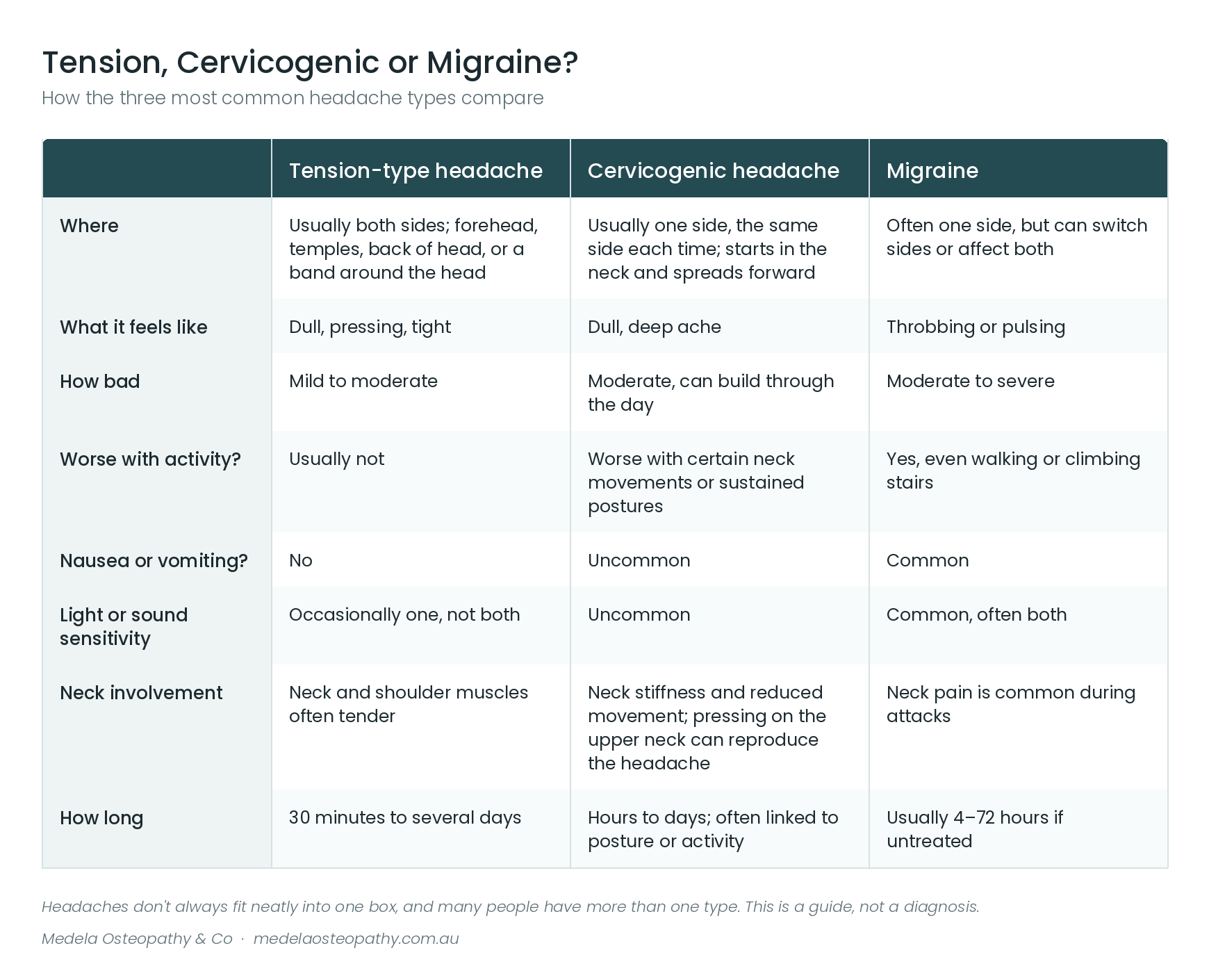
Table of headache features compared. Not intended for diagnosis. Speak to a professional before considering treatment.
Tension-type headache
Tension-type headache is the most common headache worldwide. Most people describe a tight band or pressure around the head, as if something is squeezing. It's usually on both sides and mild to moderate, so most people can keep working through it, even if they'd rather not.
Common triggers: stress, poor sleep, long periods of screen work, skipped meals, dehydration, and tension in the jaw, neck and shoulders.
What helps: managing triggers, regular movement, exercise, and treatment for tender and overworked muscles around the head, neck and shoulders. Some people with tension-type headache find manual therapy helpful, particularly when combined with exercise and changes to daily habits.
Read our full guide: Tension Headaches: Causes, Triggers and Treatment
Cervicogenic headache
A cervicogenic headache is referred pain from the neck, most often from the joints at the top of the cervical spine. Nerves from the upper neck share a pathway in the brainstem with the nerve that supplies the forehead and eye region, so a problem in your neck can be felt in your head.
Clues that your neck may be the source:
The headache stays on the same side each time.
It starts in the neck or at the base of the skull.
Certain neck movements, or long periods at a desk or behind the wheel, bring it on.
Your neck is stiff, especially when turning your head.
Pressing on the upper neck brings on your familiar headache.
What helps: cervicogenic headache has one of the stronger evidence bases for manual therapy among headache types. A well-known randomised controlled trial found that manipulative therapy and specific neck exercises each reduced headache frequency and intensity, with benefits still present at 12 months.
Read our full guides: Cervicogenic Headaches: When Your Neck Is the Source and Headache at the Base of the Skull: What It Means and What Helps
Migraine
Migraine is a neurological condition, not just a bad headache. Attacks are typically moderate to severe and throbbing, made worse by routine activity, and come with nausea, vomiting, or sensitivity to light and sound. Many people need to lie down in a dark, quiet room.
About a third of people with migraine experience aura before or during an attack. Aura is temporary visual disturbance (such as zigzag lines, flashing lights or blind spots), tingling, or difficulty speaking.
Some people also notice warning signs a day or two beforehand, such as yawning, food cravings, mood changes or neck stiffness.
Common triggers: hormonal changes, missed sleep, stress (or the let-down after stress), skipped meals, dehydration, alcohol, and certain foods for some people.
What helps: migraine is best managed with your GP, and sometimes a neurologist, because effective medications for both acute attacks and prevention are available. Keeping a headache diary, managing triggers, and regular exercise and sleep all play a role. Neck pain is very common in people with migraine, and treating the neck may be a useful part of a broader plan for some people, alongside medical care.
Other headache types worth knowing
Medication overuse headache. Taking pain relief on many days each month can itself cause more frequent headaches. If you're using pain medication for headaches regularly, speak with your GP or pharmacist.
Cluster headache. Cluster headaches are rare but extremely severe. The pain is one-sided and around the eye, lasts 15 minutes to 3 hours, and comes with a watery eye, runny nose or drooping eyelid on the same side. Attacks often come in "clusters" over weeks. These need medical management, so see your GP.
Jaw-related headache. Clenching or grinding your teeth, or a jaw joint problem, can cause pain around the temples, often worst on waking. Your dentist and osteopath can both help here.
"Sinus" headache. Many headaches people put down to their sinuses turn out to be migraine. A true sinus headache usually comes with other signs of sinus infection, such as a blocked nose, discoloured discharge or fever.
When a headache needs urgent attention
Call 000 or go to the emergency department if you have:
a sudden, severe headache that peaks within seconds to minutes
headache with fever, a stiff neck, a rash, confusion or drowsiness
headache with weakness, numbness, slurred speech, vision loss, double vision or loss of balance
a new headache after a head or neck injury
See your GP soon if you have:
a new headache pattern, particularly after age 50
headaches that are steadily worsening or changing in character
headaches that wake you from sleep, or that are worse when coughing, straining or lying down
headaches with unexplained weight loss, or a history of cancer or a weakened immune system
headaches that started during pregnancy or after childbirth
We screen for these warning signs at every headache assessment and refer to your GP whenever further investigation is needed.
Keep a headache diary
If you're not sure what type of headache you have, a two-to-four-week diary is one of the most useful things you can bring to any appointment. For each headache, note:
the date, time it started, and how long it lasted
where it hurt and what it felt like
how severe it was, on a scale of 0–10
any other symptoms, such as nausea or light sensitivity
what you were doing beforehand (desk work, driving, poor sleep, a skipped meal)
any medication you took and whether it helped
Patterns that are invisible day to day often become obvious on paper.
How we can help
At Medela Osteopathy, a headache assessment starts with working out what type of headache you have and what's driving it. We take a detailed history, screen for red flags, examine how your neck moves, and assess the joints and muscles of your neck, upper back and jaw.
If your headaches are coming from your neck or muscles, we'll build a treatment plan that combines hands-on treatment, a targeted exercise program and practical changes to your day. If your headaches need medical input, we'll tell you and work alongside your GP.
Book a headache assessment · See our osteopathy services
Medela Osteopathy & Co · Suite 9, 69 Wharf Street, Tweed Heads NSW 2485
Frequently asked questions
How do I know if my headache is from my neck? Neck-related headaches usually stay on one side, start in the neck, and are brought on by neck movements or sustained postures. The most reliable way to find out is an assessment that checks whether examining your neck reproduces your headache.
Can you have a tension headache and a migraine at the same time? Many people have both types, sometimes on different days. That's one reason a headache diary is so useful.
Is it a migraine if it's only on one side? Not necessarily. Migraines are often one-sided, but so are cervicogenic headaches. The character of the pain, associated symptoms, and triggers help tell them apart.
Do I need a referral to see an osteopath for headaches? No. Osteopaths are AHPRA-registered primary contact practitioners, so you can book directly.
This article provides general information only and is not a substitute for individual medical advice. If you have concerns about your headaches, please see your GP or a registered health practitioner.
References
Headache Classification Committee of the International Headache Society. The International Classification of Headache Disorders, 3rd edition (ICHD-3). Cephalalgia. 2018;38(1):1–211.
Jull G, Trott P, Potter H, et al. A randomized controlled trial of exercise and manipulative therapy for cervicogenic headache. Spine. 2002;27(17):1835–1843.
Bogduk N, Govind J. Cervicogenic headache: an assessment of the evidence on clinical diagnosis, invasive tests, and treatment. Lancet Neurology. 2009;8(10):959–968.
Schreiber CP, Hutchinson S, Webster CJ, et al. Prevalence of migraine in patients with a history of self-reported or physician-diagnosed "sinus" headache. Archives of Internal Medicine. 2004;164(16):1769–1772.
Do TP, Remmers A, Schytz HW, et al. Red and orange flags for secondary headaches in clinical practice: SNNOOP10 list. Neurology. 2019;92(3):134–144.