You wake up with a dull ache in your temples. Your jaw feels tired before you've eaten breakfast, and your teeth feel strangely sore. By mid-afternoon, after a few hours at the desk, the headache has settled in properly.
If that sounds familiar, your jaw may be part of the story. The temporomandibular joint (TMJ) and the muscles that move it are one of the most overlooked sources of headache we see in the clinic. In this article we'll explain how jaw problems cause head pain, the signs to look out for, what you can do at home, and when it's worth getting it assessed.
What is the TMJ?
Your temporomandibular joint is the hinge that connects your lower jaw to your skull. You have one on each side, just in front of your ears. Put your fingertips there and open your mouth, and you'll feel it move.
It's one of the busiest joints in the body. You use it to talk, chew, swallow and yawn, often thousands of times a day. It's also unusual: it both hinges and slides, and the left and right sides have to work together.
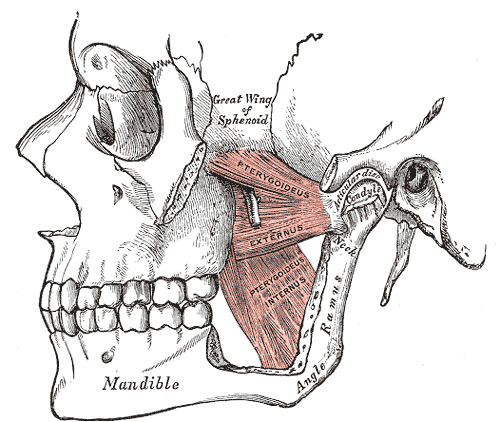
The joint is moved by a group of chewing muscles:
Masseter: the thick muscle at the angle of your jaw. Clench your teeth and you'll feel it bulge. For its size, it's one of the strongest muscles in the body.
Temporalis: a fan-shaped muscle across your temple. It helps close and pull back the jaw.
Medial and lateral pterygoids: deeper muscles on the inside of the jaw. They help open, close and move the jaw side to side. They can't be felt from outside the face, which is why they're so often missed.
Can TMJ problems actually cause headaches?
Yes. The International Classification of Headache Disorders, the system doctors and researchers use to diagnose headaches, lists "headache attributed to temporomandibular disorder" as its own diagnosis. It notes this headache is usually felt in the temples, on one or both sides, and that it overlaps a lot with tension-type headache.
The link shows up in the numbers too. Studies report that between 48% and 77% of people with jaw dysfunction have headaches, compared with around 45% of the general population. Migraine and tension-type headache are both more common in people with TMJ symptoms.
There are three main ways the jaw can drive head pain:
Referred pain from overworked muscles. Tight, overloaded chewing muscles refer pain to other places. The temporalis commonly refers into the temple and above the eye. The masseter can refer into the cheek, the teeth and around the ear. The pterygoids can produce a deep ache behind the eye or in front of the ear.
An irritated joint. The joint itself, and the small disc inside it, can become inflamed or strained. This often shows up as pain in front of the ear that spreads into the side of the head.
Clenching and grinding (bruxism). Many people clench during the day without noticing, at the desk, in traffic or while lifting at the gym. Others grind at night. Either way, the jaw muscles work for hours when they should be resting, which is why these headaches are often worse first thing in the morning or late in the day.
Signs your headache might be coming from your jaw
Jaw-related headaches tend to come with some tell-tale signs. You might notice:
Pain in your temples, around your ears or along your jaw
Headaches that are worse when you wake up, or after chewing, talking a lot or a long day at the desk
Clicking, popping or catching when you open your mouth
A jaw that feels tired, tight or stiff
Difficulty opening your mouth fully, or your jaw shifting to one side as it opens
Sore or sensitive teeth, or worn, flattened teeth your dentist has commented on
Tender spots when you press on your temples or the angle of your jaw
A partner who hears you grinding at night
None of these on their own confirm the jaw is the cause. But if several sound familiar, it's worth having your jaw looked at as part of a headache assessment.
The jaw–neck connection
Jaw problems rarely travel alone. The jaw, upper neck and base of the skull are closely linked through shared muscles, nerves and posture. When one is overloaded, the others often follow.
Research suggests this works in both directions: tension-type headache and migraine are linked with problems in the neck muscles, the chewing muscles, and stress-related factors. Think of the person hunched over a laptop with their head poking forward. The neck is working harder, the jaw tends to clench, and the headache that follows usually has more than one source.
That's why we rarely treat the jaw on its own. If your headaches also involve neck stiffness or pain at the base of your skull, these articles are worth a read:
What you can do at home
These simple habits can take a lot of load off an overworked jaw:
Find your resting jaw position. Lips together, teeth apart, tongue resting gently on the roof of your mouth just behind your front teeth. Your teeth should only touch when you're chewing or swallowing.
Catch yourself clenching. Put a small sticker on your monitor, phone or steering wheel. Each time you see it, check your jaw and let it relax.
Give it a break during a flare. Choose softer foods for a few days, cut food into smaller pieces, and skip chewing gum, tough meat and very crunchy foods.
Use heat. A warm compress over the side of your face for 10 to 15 minutes can ease tight jaw muscles.
Watch your posture. Bring your screen up to eye level so your head isn't poking forward for hours at a time.
Look at the bigger picture. Stress and poor sleep both drive clenching and grinding. Anything that improves them is likely to help your jaw too.
If you grind at night, talk to your dentist about whether an occlusal splint (night guard) is right for you. It can protect your teeth and reduce load on the joint.
How an osteopath can help with jaw-related headaches
Assessment
We start by working out where your headaches are actually coming from. That means a thorough history, then an assessment of:
How your jaw opens, closes and moves side to side, including any clicking, catching or deviation
The chewing muscles, both outside the face and inside the mouth
Your neck, upper back and the base of your skull
Posture and work set-up, plus any habits like clenching, grinding or gum chewing
We'll also screen for anything that needs a referral to your GP or dentist.
Treatment, including intraoral work
Treatment depends on what we find, but for jaw-related headaches it often includes:
Intraoral (inside the mouth) muscle work. Some of the most important jaw muscles can only be reached from inside the mouth. Wearing gloves, we gently work on the masseter from the inside of the cheek, and on the pterygoid muscles. This is often where we find the tightest, most tender spots. Pressure on these muscles often reproduces a person's familiar headache, which helps confirm where it's coming from. We'll always explain what we're doing first, and you can stop at any time.
Soft tissue work outside the face, including the masseter and temporalis
Gentle joint mobilisation of the TMJ to help it move more freely
Treatment of the neck and upper back, where these are contributing
Dry needling of the jaw and neck muscles, if you're comfortable with it. We'll always discuss it with you first, and it's never a required part of treatment.
Exercises and advice to retrain jaw control, relax the chewing muscles and manage clenching habits
We also work alongside dentists. If you need a splint, or there's a dental issue contributing, we'll let you know.
The research here is encouraging. In patients diagnosed with jaw-related headache, studies have found headaches improve as jaw symptoms are treated, and the two tend to improve together. Everyone responds differently, so we'll discuss what to expect and how many sessions are likely at your first appointment.
When to see a dentist or GP instead
Most jaw pain and jaw-related headaches are not serious. But some symptoms need a prompt check with your GP or dentist, or emergency care:
Your jaw is locked open or locked shut
Swelling of the face or jaw, fever, or a bad taste suggesting infection
Numbness or tingling in your face, lips or tongue
Pain after a fall, a knock to the face or a car accident
Tooth pain, a cracked tooth, or pain that's clearly centred on one tooth
A new headache after age 50, especially with jaw pain when chewing, scalp tenderness or changes in your vision. See your GP the same day.
A sudden, severe headache, or a headache with weakness, confusion, slurred speech or a stiff neck. Call 000.
If we find anything like this during your assessment, we'll refer you on.
Frequently asked questions
Can TMJ problems cause headaches?
Yes. Headache caused by a temporomandibular disorder is a recognised diagnosis. It's usually felt in the temples on one or both sides, and often overlaps with tension-type headache.
Is jaw clicking a problem?
Not always. Clicking on its own, without pain or locking, is common and often harmless. It's worth getting assessed if the clicking is painful, getting worse, or your jaw catches or locks.
Should I see a dentist or an osteopath for TMJ?
Often both. A dentist checks your teeth and bite and can make a splint if you grind. An osteopath assesses and treats the jaw muscles, the joint and the neck. The two approaches work well together.
Does a night guard help with headaches?
A night guard (occlusal splint) protects your teeth from grinding and can reduce load on the jaw. Some people find their morning headaches ease with one. Your dentist can advise whether it suits you.
What is intraoral jaw treatment?
It's hands-on treatment of the jaw muscles from inside the mouth, done with gloves. It lets us reach the masseter from the inside and the deeper pterygoid muscles, which can't be reached from outside the face.
How long does it take for a TMJ headache to settle?
It varies. Some people notice a change within a few sessions, especially when they also work on clenching habits. Long-standing problems usually take longer. We'll give you a clearer idea after your assessment.
The bottom line
If your headaches sit in your temples, are worse in the morning or after a long day, and come with a tired or clicking jaw, your TMJ and chewing muscles may be part of the picture. It's an easy source to miss, especially when the neck gets most of the attention.
Headaches are personal for me. I had chronic daily headaches through uni, and it was an osteopath who finally helped me make sense of them. That's a big part of why headache care is such a focus at Medela. We look at the whole picture, jaw included, and we'll work with your GP or dentist when needed.
If you're in the Tweed Heads, Coolangatta or southern Gold Coast area and want your headaches properly assessed, you can book a consultation online. You can also read more about how we approach headaches on our Headache & Migraine page.
This article is general information and isn't a substitute for an individual assessment. If you're worried about your symptoms, see your GP.
References
Headache Classification Committee of the International Headache Society. ICHD-3: 11.7 Headache attributed to temporomandibular disorder (TMD).
Study of headache diagnoses in patients with temporomandibular disorders (PMC5379086).
Headache attributed to temporomandibular disorders and masticatory myofascial pain. Journal of Oral Science, 2016.
Gray H. Anatomy of the Human Body, 20th ed. 1918 (illustrations, public domain).